In daily snacks, ready to eat meat slices with a crispy texture are a favorite of many people. With the development of processing technology, microwave drying and roasting technology is increasingly being applied to the production of meat slices, which can create a crispy texture and meet the demand for ready to eat.
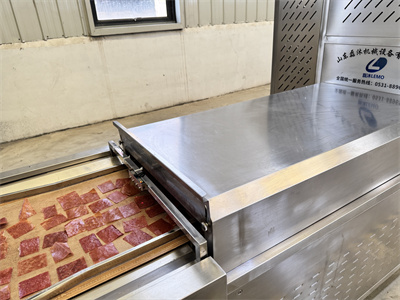
To understand microwave drying and roasting of cooked meat slices, one must first understand the core function and logic of microwaves. Microwave is a high-frequency electromagnetic wave, similar to the light waves we encounter in our daily lives, but with a higher frequency. The way it heats ingredients is very special, it does not slowly penetrate from the surface like traditional methods, but directly "penetrates" the meat slices and interacts with the water molecules inside the meat slices. The water molecules in meat slices are polar molecules. When microwave is irradiated, the water molecules vibrate and rotate at a high speed of billions of times per second, constantly rubbing and colliding with each other, instantly generating a large amount of heat. Simply put, microwave directly causes the meat slices to "heat up on their own", and it heats up both inside and outside simultaneously.

Let's take a look at the combination process of drying and baking. When making meat slices, raw meat itself contains a lot of moisture, which is the key factor affecting the taste. During microwave heating, the moisture inside the meat slices is rapidly heated and quickly vaporized into water vapor. If the meat slices and microwave parameters are controlled well at this time, the internal water vapor can generate a certain pressure, gradually spreading the fiber structure of the meat slices. At the same time, microwaves will continue to remove moisture from the surface of the meat slices, achieving a drying effect.

The 'micro puffing effect' here refers to the result of the vaporization of water and the expansion of fibers. The main components of meat slices are protein and fat. Under the dual effects of microwave high temperature and water vaporization, the protein undergoes denaturation, the structure becomes loose, and the originally tight flesh fibers are stretched open, forming tiny pores. This pore structure is not completely expanded large pores, but fine and tiny pores, also known as "micro expansion". This structure not only prevents the meat slices from becoming too soft, but also greatly increases the crispness of the taste, because when bitten, these tiny pores will be easily crushed, while locking in a small amount of water, making the taste dry and dry.

And 'roasted' is a natural result of microwave heating. As the moisture is gradually dried, the temperature of the meat slices continues to rise. When the temperature reaches the point of protein denaturation and fat melting, the meat slices have completed the roasting process. At the same time, high temperatures release flavor compounds from meat slices, creating a meaty aroma that meets the flavor requirements for ready to eat meals.




 QQ
QQ